
Table of Contents
- Educational Board Games vs. Learning Apps: Which Is Right for Your Toddler?
- Quick Comparison: Top Educational Games for Toddlers
- The Sneaky Snacky Squirrel Game: Fine Motor Fun
- Sequence Letters: Building Early Literacy Foundations
- Khan Academy Kids: A Free Digital Learning Powerhouse
- Educational Board Games for 2 Year Olds: What Works Best
- Why Play Matters: Benefits of Play-Based Learning for Preschoolers
- How to Choose Age-Appropriate Educational Toys and Games
- Screen Time Guidelines and Parental Controls
- Where to Find Quality Games and Support
- Frequently Asked Questions
Last Updated: September 7, 2026
Educational Board Games vs. Learning Apps: Which Is Right for Your Toddler?
The search for the best educational games for toddlers usually begins with a phone in one hand and a toy catalog in the other. Parents face a genuine fork in the road: hand over a tablet with a curated learning app, or sit on the floor with a physical board game.
Board games build fine motor coordination, turn-taking, and social interaction through tactile play. Digital apps excel at interactive learning, phonics, and numeracy with adaptive pacing. The real question is which tool fits the specific skill you want to nurture right now.
Many parents assume digital tools are more "educational" because they look polished. In practice, the opposite is often true: physical games teach patience, hand-eye coordination, and the social rules of winning and losing.
Quick Comparison: Top Educational Games for Toddlers
The market splits cleanly into two categories: physical board games and digital learning apps. Here is how the top options stack up across the criteria parents actually care about.
| Game | Type | Starting Price | Core Skills | Screen Time |
|---|---|---|---|---|
| The Sneaky Snacky Squirrel Game | Board game | $24.99 | Fine motor, colors, turn-taking | None |
| Sequence Letters | Board game | $17.99 | Letter recognition, phonics | None |
| Khan Academy Kids | Digital app | Free | Reading, math, social-emotional | Required |
| Lingokids | Digital app | $5.99/month | Language, math, life skills | Required |
| ABCya | Web platform | Free | Letters, numbers, logic | Required |
TL;DR:
- For screen-free skill building, The Sneaky Snacky Squirrel Game and Sequence Letters are the strongest physical picks
- For free digital learning with no ads, Khan Academy Kids is the clear winner
- Balance both formats: physical games for social and motor skills, apps for independent practice
The Sneaky Snacky Squirrel Game: Fine Motor Fun
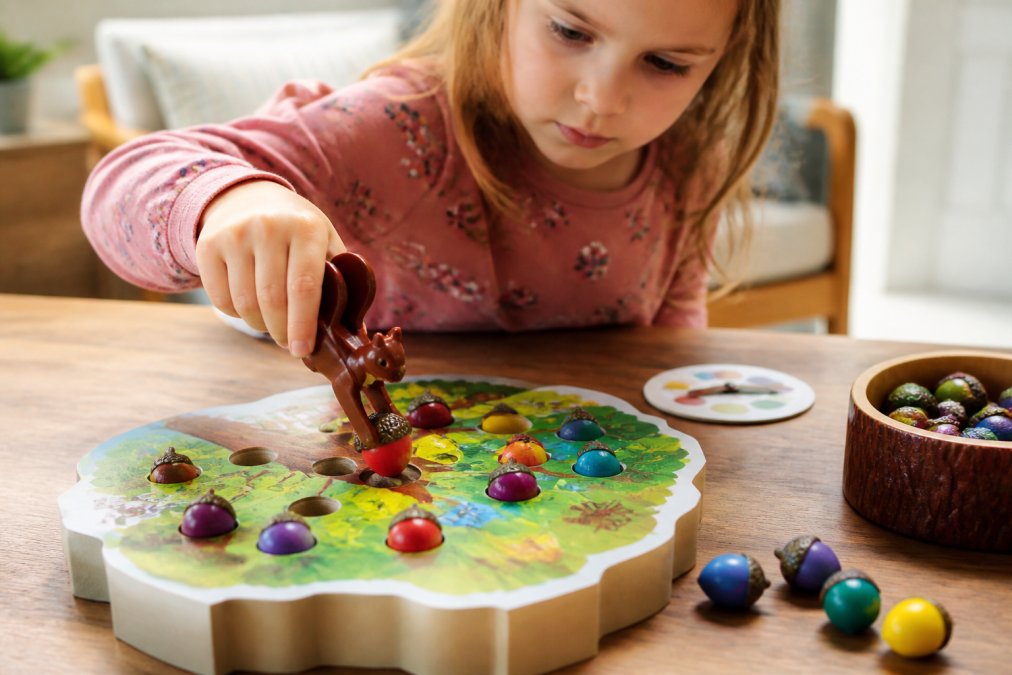
The Sneaky Snacky Squirrel Game is known for its fine motor skill development. Toddlers use a squirrel-shaped squeezer to pick up colored acorns and match them to their tree stump, building hand strength and hand-eye coordination with every turn. The gameplay is simple enough for ages three and up, yet it introduces strategic thinking as children decide which acorn to grab first.
The game also teaches color matching and turn-taking, both critical for preschool readiness. One honest limitation: the acorns are small, so adult supervision is essential for younger toddlers.
Sequence Letters: Building Early Literacy Foundations
Sequence Letters adapts the classic Sequence format for early literacy. Players match letter cards to pictures on the board, reinforcing letter recognition and phonics. The game grows with the child as they move from matching letters to sounding them out.
The game requires adult supervision for younger players, but that is part of its value: playing together creates natural opportunities to talk about letter sounds and vocabulary. Sequence Letters can be an effective educational board game for 2 year olds beginning to show interest in the alphabet.
Khan Academy Kids: A Free Digital Learning Powerhouse
Khan Academy Kids is completely free with no ads, no subscriptions, and no in-app purchases. It offers a personalized learning path covering reading, writing, math, and social-emotional development, with offline access for car trips and waiting rooms.
The content aligns with early learning standards, giving parents confidence that screen time is productive. The interface is intuitive enough for a toddler to navigate independently, which supports independent play. The one drawback is the obvious one: it requires a tablet or smartphone. For parents who have already decided to allow some screen time, Khan Academy Kids is the highest-quality free option available. The Khan Academy Kids official site provides full details on the curriculum and offline capabilities.
Educational Board Games for 2 Year Olds: What Works Best
Two-year-olds lack the attention span and fine motor control for complex rules. The educational board games for 2 year olds that work best focus on a single skill with immediate, satisfying feedback.
The Mechanics That Work at Age 2
At this age, mechanics matter more than theme. Look for these specific mechanics:
- Push, Pull, and Drop: Games where the primary action is pushing a button, pulling a lever, or dropping a token into a slot. This satisfies their need for cause-and-effect learning. A classic example is a simple coin-drop box or a game like Pop the Pig (with adult help) where the action is purely physical.
- Large-Piece Matching: Games with chunky, oversized pieces that are easy for small hands to grasp and manipulate. Look for pieces that are at least 2 inches in diameter to prevent choking hazards and ensure a successful grip. The Sneaky Snacky Squirrel Game works well because the squeezer is large, but the acorns are small, so it requires supervision. A better pure-matching option for this age is a set of large, textured puzzle pieces that fit into a corresponding board.
- Single-Step Instructions: The game should have one rule: 'Find the red one' or 'Put the cow in the barn.' Games with multiple steps or turn-taking sequences will lose their attention quickly.
- Immediate Feedback: The reward should be instant. A piece that clicks into place, a light that flashes, or a sound that plays upon a correct match. This reinforces the learning loop without requiring a parent to explain the outcome.
Top Picks for the 2-Year-Old Crowd
While The Sneaky Snacky Squirrel Game is a fantastic choice for a 3-year-old, for a younger toddler, consider these specific types of games that are often overlooked:
- First Orchard (HABA): This is a cooperative game, meaning everyone plays together against the 'raven.' The pieces are large, wooden, and beautifully colored. The rules are simple: pick a fruit from the tree and place it in the basket. It teaches color recognition and the concept of a shared goal without the pressure of winning or losing.
- My First Scavenger Hunt: This isn't a board game but a card-based game where you hold up a card with a picture of an item (e.g., a blue square) and the toddler has to find that item in the room. It's a fantastic way to build vocabulary and observation skills with zero setup.
- Simple Wooden Shape Sorters: While not a 'board game' in the traditional sense, a high-quality shape sorter is a game. It teaches shape recognition, problem-solving, and fine motor control. The best ones have a clear top that is easy to remove and pieces that are easy to grasp.
The 'Two-Minute Rule' for Gameplay
Early childhood educators recommend the 'two-minute rule': do not expect a 2-year-old to sit through a 10-minute game. Play for two minutes, have a positive interaction, and then let them walk away. Forcing a toddler to finish a game creates negative associations with structured play.
What to Avoid
- Games with Small Pieces: Anything with pieces smaller than a toilet paper roll is a choking hazard and will cause more stress than learning.
- Games with Complex Rules: If you have to explain more than one rule, it's too complex.
- Competitive Games: Games with a clear winner and loser are emotionally overwhelming for a 2-year-old. Cooperative games or games without a winner are far more appropriate.
Why Play Matters: Benefits of Play-Based Learning for Preschoolers
The benefits of play-based learning for preschoolers extend far beyond keeping a child occupied. Play is how young children process the world, build cognitive skills, and develop the social-emotional toolkit they need for kindergarten.
Research on early childhood development consistently shows that play-based learning supports problem-solving, logical reasoning, and spatial awareness. Physical games add the crucial element of social interaction: children learn to wait their turn, handle losing, and cooperate toward a shared goal. These skills are difficult to teach through a screen because they require real-time human feedback. The American Academy of Pediatrics guidance on play emphasizes that play is essential for healthy brain development, not a break from learning.
How to Choose Age-Appropriate Educational Toys and Games
Choosing age-appropriate educational toys requires looking past marketing claims and matching the game to your child's actual developmental stage. The age range on a box is a starting point, not a guarantee.
Assess three things: fine motor readiness, attention span, and existing skill level. If you answer no to any of these, the game will likely frustrate them. Look for games that teach one skill slightly beyond their current level.
Screen Time Guidelines and Parental Controls
Digital learning games raise legitimate concerns that go beyond just 'how much screen time.' For parents of toddlers, the more pressing questions are often about what the app is doing behind the scenes.
The Privacy and Data Collection Question
In the free app market, the 'free' product is often your child's data. Before downloading any app, check its privacy policy for three specific things:
- Data Shared with Third Parties: Does the app share information (like device ID, location, or usage patterns) with advertising networks or data brokers? Look for a clear 'Data Not Linked to You' or 'Data Used to Track You' label in the app store's privacy section.
- Advertising and Tracking: The Children's Online Privacy Protection Act (COPPA) restricts the collection of personal information from children under 13 without parental consent (the FTC). However, many apps use 'advertising identifiers' that can track a child's activity across other apps. The most trustworthy apps are those that are explicitly certified as COPPA-compliant and ad-free, such as Khan Academy Kids.
- In-App Purchases: A 'free' game with in-app purchases can lead to accidental charges and is a sign that the app's primary goal might be monetization, not education. The best apps for toddlers have no in-app purchases at all, removing the risk of a toddler inadvertently buying a virtual item.
Setting Up a Safer Digital Environment
Beyond choosing the right app, control the device environment. On iOS and Android, the most effective control is Guided Access (iPad/iPhone) or Screen Pinning (Android). These features lock the child into a single app, preventing accidental exits, ad taps, or navigation to other parts of the device.
A Practical Framework for Digital Play
A practical framework sometimes recommended is the '3-2-1 Rule':
- 3: No more than 3 educational app sessions per day.
- 2: Each session should be no longer than 2 minutes per year of age (e.g., a 3-year-old gets a 6-minute session).
- 1: For every 1 minute of screen time, ensure at least 1 minute of physical, active play follows.
This framework moves parents beyond a vague time limit and prevents the tablet from becoming a default babysitter. Treat the app as a tool for independent practice, not a replacement for the social and physical learning that happens with board games and outdoor play.
Where to Find Quality Games and Support
Curious Turtle: Books, Toys and Games in downtown Jefferson City offers a curated selection of books, toys, and games, with staff who can recommend options based on your child's developmental stage. Unlike a big-box retailer, a curated shop narrows choices to items with proven educational value.
The shop features works by beloved Missouri authors and provides a community space for families exploring discovery and play. For parents who want to feel the weight of a game piece, flip through a picture book, or ask a real person whether a game suits a particularly energetic toddler, a local independent store offers something algorithms cannot: human judgment. The Curious Turtle official website provides current inventory and event details.
Choosing the best educational games for toddlers comes down to matching the tool to the skill and the child. Physical board games build fine motor coordination, social skills, and patience. Digital apps deliver interactive learning and independent practice. The strongest approach uses both, with screen-free games as the foundation and quality apps as a supplement. Visit Curious Turtle: Books, Toys and Games downtown to explore options in person.
Frequently Asked Questions
What are some of the best free educational games for toddlers?
Khan Academy Kids stands out as a top free option. It offers a complete curriculum covering reading, math, and social-emotional skills without ads or subscription fees. The app provides a personalized learning path for each child and works offline once downloaded. For a screen-free choice, classic matching games or simple puzzles from your local toy store offer free-form learning, though they require an adult to guide play.
What are some educational games for a 2-year-old?
For this age, focus on games that build fine motor skills and basic recognition. Look for educational board games for 2 year olds like The Sneaky Snacky Squirrel Game, which uses a squeezer to develop hand strength while teaching colors. Simple puzzles and matching games also work well. These games encourage turn-taking and social interaction, which are key skills for toddlers, without demanding advanced reading or counting.
Are board games or digital apps better for toddler learning?
Both formats offer distinct benefits. Physical board games excel at developing social skills like turn-taking, patience, and communication, while also building fine motor coordination through tactile pieces. Digital apps like Khan Academy Kids or Lingokids can personalize learning and introduce interactive content that adapts to your child's pace. A balanced approach that includes both types of educational games often works best, with clear limits on screen time.
How do educational games support early childhood development?
Educational games target several core areas of early childhood development simultaneously. Board games build fine motor skills and social-emotional learning through turn-taking and handling small pieces. Digital apps often focus on cognitive skills like pattern recognition and problem-solving. Both formats can reinforce literacy foundations, such as letter recognition, and numeracy skills through counting. The key is choosing games that match your toddler's current developmental stage.
What should I look for when choosing educational games for toddlers?
To choose age-appropriate educational toys, first check the manufacturer's age recommendation and look for sturdy, durable parts without small pieces that pose a choking hazard. Evaluate the skills the game targets: does it build fine motor coordination, letter recognition, or problem-solving? Consider the format, whether you want a screen-free board game or a digital app, and prioritize options with an ad-free experience and no in-app purchases for digital choices.